

The Rocket Solid Propulsion Market is Projected to Grow at a 4.2% CAGR by 2030
Rocket Solid Propulsion Market Report
Rocket Solid Propulsion Market Report share
Rocket Solid Propulsion Market Report size
The Business Research Company’s Rocket Solid Propulsion Global Market Report 2026 – Market Size, Trends, And Forecast 2026-2035
LONDON, GREATER LONDON, UNITED KINGDOM, October 16, 2026 /EINPresswire.com/ -- "The rocket solid propulsion sector is set for substantial growth as aerospace and defense industries continue to expand rapidly. With the increasing demand for advanced missile systems and space exploration missions, this market is positioned to witness significant developments by 2030. Let’s explore key market aspects such as size, regional dominance, growth drivers, major players, and future opportunities shaping this dynamic field.
Forecasted Market Size and Regional Leadership in Rocket Solid Propulsion
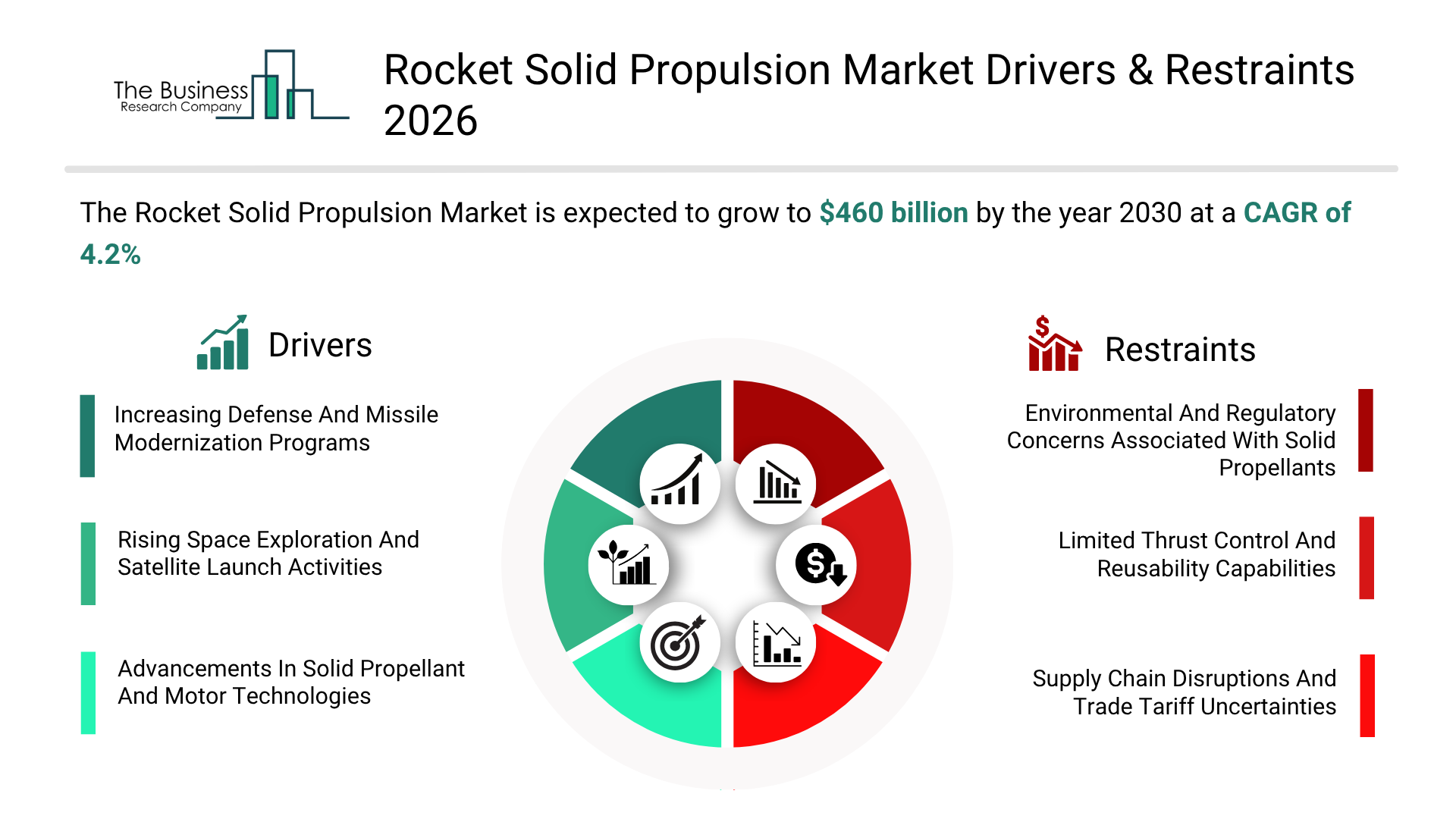
The rocket solid propulsion market is projected to exceed $460 billion by 2030, forming a significant part of the broader Aerospace & Defense industry, which itself is expected to reach $1,166 billion by the same year. This segment will represent nearly 39% of the total market value, underscoring its critical role within the aerospace and defense sectors.
Request A Free Sample Of The Rocket Solid Propulsion Market Report
https://thebusinessresearchcompany.com/sample_request?id=41036791&type=smp&name=Rocket%20Solid%20Propulsion%20Market%20Report%202026&utm_source=EINPresswire&utm_medium=Paid&utm_campaign=Oct_PR
North America’s Role as the Dominant Market for Rocket Solid Propulsion
In 2030, North America is anticipated to be the leading region in the rocket solid propulsion market, with a valuation of $163 billion. The market is forecasted to grow from $131 billion in 2025 at a compound annual growth rate (CAGR) of 4%. This steady expansion is driven by escalating investments in national defense and missile modernization, increased commercial and governmental space launch activities, advancements in solid propellant technology, and the region’s robust aerospace manufacturing infrastructure in the USA and Canada.
The United States as the Key Country Powering Market Growth
The USA is expected to top the global rocket solid propulsion market by 2030, with a market size valued at $143 billion. It is projected to grow from $116 billion in 2025 at a CAGR of 4%. This increase stems from consistent funding for strategic defense programs, rising deployment of advanced tactical and strategic missiles, government-private sector collaborations, and ongoing investments in propulsion testing and manufacturing innovations.
Access The Detailed Rocket Solid Propulsion Market Report Here
https://thebusinessresearchcompany.com/report/rocket-solid-propulsion-global-market-report?utm_source=EINPresswire&utm_medium=Paid&utm_campaign=Oct_PR
Leading Segment Within the Rocket Solid Pronpulsion Market in 2030
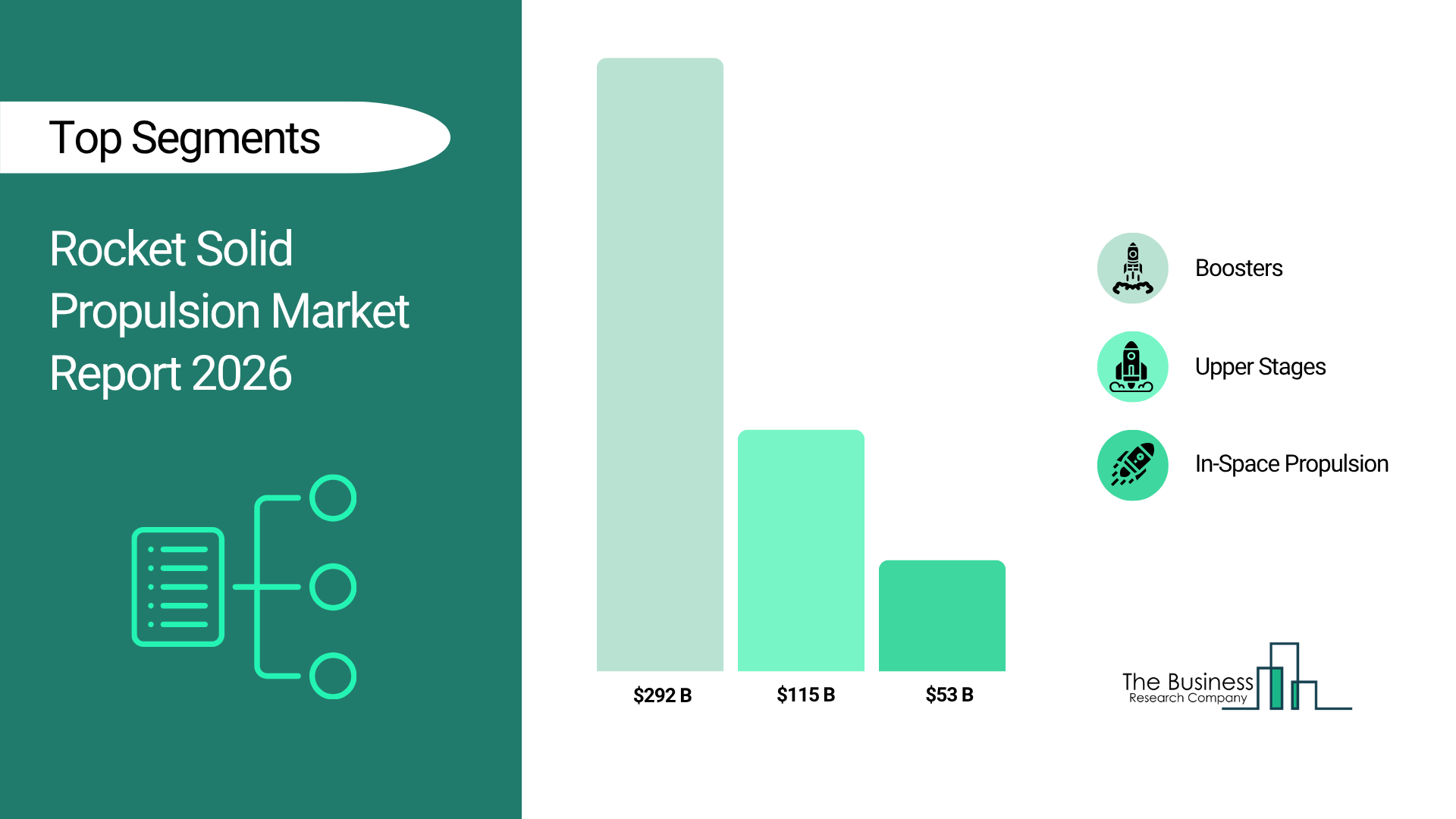
Among various product types, boosters will dominate the rocket solid propulsion market segment in 2030, accounting for 64% or $292 billion of the total market. This dominance is fueled by the widespread use of solid rocket boosters in heavy lift launch vehicles, the military’s preference for high-thrust propulsion systems, improved reliability and storage benefits over other propulsion types, and rising satellite deployment missions. Continuous improvements in booster design and efficiency also contribute significantly to this sector’s growth.
Detailed Market Segmentation by Rocket Type, Propellant, Application, and End User
The rocket solid propulsion market is categorized by rocket type into launch vehicles, spacecraft propulsion, and military rockets. Propellant types include ammonium perchlorate composite propellant (APCP), hydroxyl-terminated polybutadiene (HTPB), and polyurethane (PU). Application areas cover earth observation, navigation, communication, and space exploration, while end users are segmented into government, commercial, and research institutions, reflecting the diverse demand across sectors.
Growth Rate Outlook Leading to 2030
The market is expected to grow at a steady CAGR of 4% through to 2030, driven by various technological advancements and increasing defense and space mission requirements.
First Factor Driving Market Expansion: Defense and Missile Modernization Programs
A primary force behind the market’s growth is the global increase in defense and missile modernization initiatives. Governments are prioritizing enhanced national security through deploying sophisticated missile systems, strategic deterrents, and next-generation tactical weapons. Solid propulsion systems are favored due to their fast launch readiness, reliability, and long shelf life. Investments in hypersonic and precision-guided missiles are also fueling demand for high-performance solid rocket motors, contributing approximately 2.8% growth annually.
Second Factor Propelling Growth: Space Exploration and Satellite Launch Boost
The surge in space exploration and satellite launch activities is another vital growth driver. Expanding satellite constellations, deep-space missions, and lunar exploration programs require dependable propulsion technologies capable of supporting complex launch and orbital operations. Solid propulsion is widely used in these applications due to its proven performance. The increased involvement of commercial space firms and national agencies has accelerated launch rates, contributing about 2.5% annual market growth.
Ongoing Technological Advancements in Propellant and Motor Systems
Innovations in solid propellant chemistry, motor casing materials, and propulsion design are enhancing thrust efficiency, consistency, and mission flexibility. Manufacturers are focusing on improving energy density, simplifying production, and boosting safety standards. These technological strides enable more efficient launches and support a wide array of defense and space projects, adding roughly 2.3% annual growth to the market.
Major Growth Opportunities Across Key Segments by 2030
The most promising expansion is expected in the boosters, upper stages, and in-space propulsion segments, which together will generate more than $86 billion in value by 2030. This surge is due to rising demand for heavy-lift launch systems, increased military missile deployments, growth in satellite constellation programs, and investments in deep-space missions. Continuous improvements in propulsion architectures are also accelerating progress across the rocket solid propulsion ecosystem.
Market Value Growth Projections Within Segments Through 2030
From 2025 to 2030, the boosters segment is projected to grow by $54 billion, the upper stages by $23 billion, and in-space propulsion by $9 billion. The market is led by a combination of global aerospace giants and specialized propulsion developers emphasizing advanced propellant formulas, lightweight composite casings, precision manufacturing, and improved thrust control to meet evolving needs.
Top Industry Leaders Steering the Rocket Solid Propulsion Market
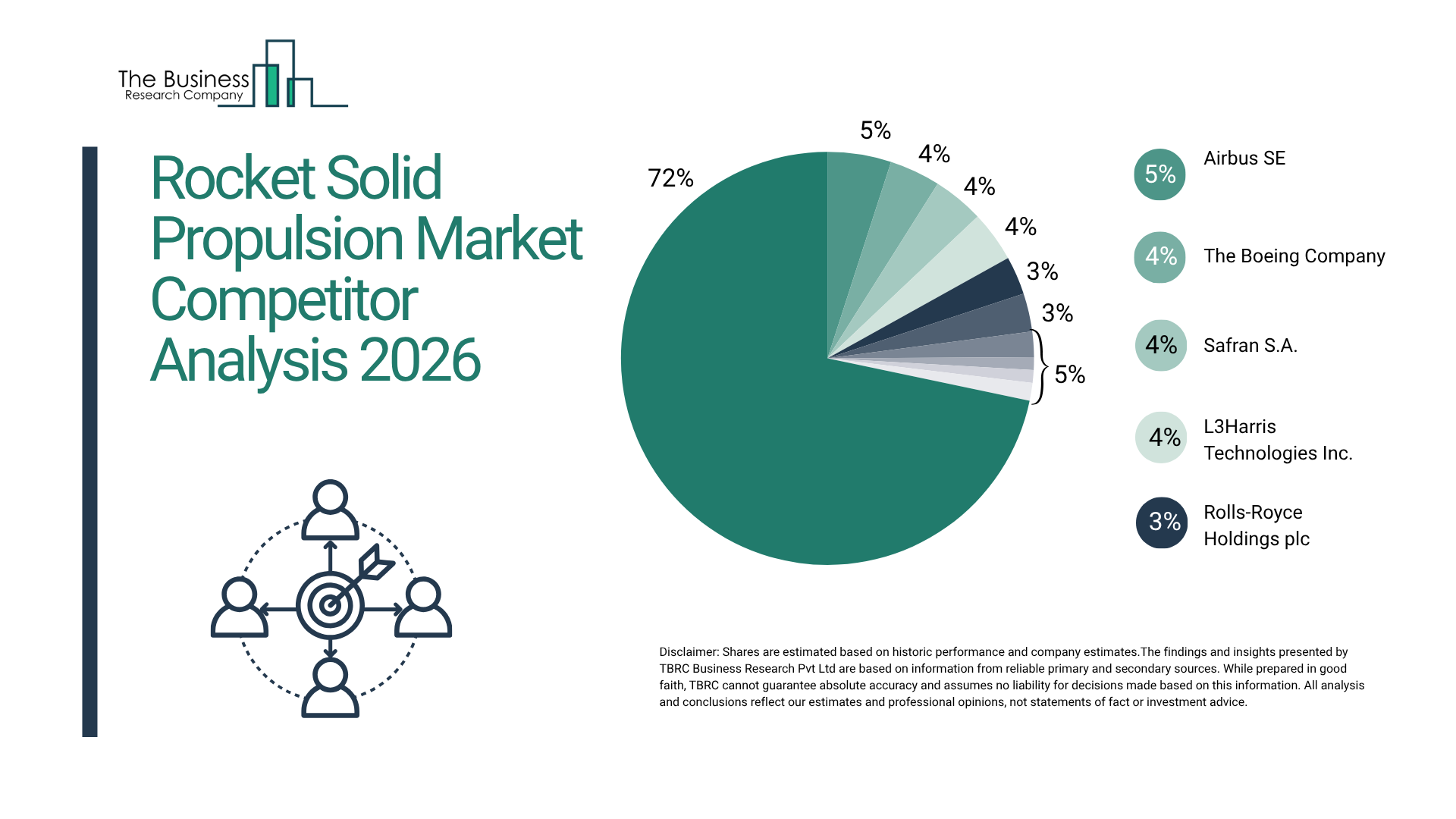
Airbus SE emerged as the global sales leader in 2025 with a 5% market share. Its involvement in space systems and launch vehicle technologies spans missile propulsion, satellite deployment, and advanced transport platforms that enhance mission success, payload delivery, and defense capabilities across commercial, governmental, and scientific programs.
Other Prominent Players Shaping the Global Market
Key companies active in the rocket solid propulsion industry include Airbus SE, The Boeing Company, Safran S.A., L3Harris Technologies Inc., Rolls-Royce Holdings plc, Mitsubishi Heavy Industries Ltd., Northrop Grumman Corporation, MBDA, Aerojet Rocketdyne Holdings Inc., Roketsan A.S., NAMMO AS, Sierra Nevada Corporation, Avio S.p.A., Arianespace SA, Skyroot Aerospace Private Limited, Anduril Industries Inc., Gilmour Space Technologies Pty Ltd., EDePro, Firehawk Aerospace Inc., and Virgin Galactic Holdings Inc.
Market Structure and Competitive Landscape
The rocket solid propulsion market is moderately fragmented, with the top 10 companies accounting for 28% of revenue in 2025. This reflects the high technical expertise, rigorous testing, mission-critical performance needs, and significant investments essential for propulsion system development. Leading firms such as Airbus SE, The Boeing Company, and Safran S.A. hold substantial shares through advanced technology portfolios, strong government contracts, and established launch programs. Increasing demand for missile systems and space missions will likely boost innovation and manufacturing capacity, strengthening these companies’ positions.
Major Raw Material Suppliers Supporting the Industry
Important suppliers of raw materials for rocket solid propulsion include Chemours Company, ICL Group Ltd., American Pacific Corporation, Albemarle Corporation, Westlake Corporation, Orica Limited, BASF SE, Evonik Industries AG, Arkema S.A., Dow Inc., Huntsman Corporation, Wanhua Chemical Group Co., Ltd., Momentive Performance Materials Inc., Cabot Corporation, Hexcel Corporation, Solvay S.A., Teijin Limited, Toray Industries, Inc., and ATI Inc.
Leading Distributors and Wholesalers in the Market
Key wholesalers and distributors servicing the rocket solid propulsion market encompass Wesco International, Inc., RS Group plc, Avnet, Inc., Arrow Electronics, Inc., Mouser Electronics, Inc., DigiKey Corporation, Motion Industries, Inc., Applied Industrial Technologies, Inc., ERIKS N.V., MSC Industrial Supply Co., Fastenal Company, Kaman Corporation, Brammer plc, Brenntag SE, Univar Solutions Inc., Aerospace & Defense Products, Inc., Pattonair (Incora), Incora, and DNOW Inc.
Principal End Users Driving Demand
The primary consumers of rocket solid propulsion products include notable organizations such as NASA, the European Space Agency, ISRO, JAXA, CNSA, Roscosmos, SpaceX, Blue Origin, United Launch Alliance, Rocket Lab USA, Relativity Space, Firefly Aerospace, Axiom Space, the U.S. Department of Defense, French Armed Forces, UK Ministry of Defence, Indian Ministry of Defence, Japan Ministry of Defense, and the Australian Department of Defence.
Emerging Competitive Trends Influencing Market Dynamics
Significant investments aimed at expanding solid rocket motor manufacturing capacity are reshaping the market by securing propulsion supply chains, scaling missile production, and boosting defense readiness. For example, in January 2026, L3Harris Technologies launched a Missile Solutions division alongside a proposed $1 billion investment to enhance solid rocket motor production for key defense programs, supporting systems like PAC-3, THAAD, Tomahawk, and Standard Missile. These efforts improve supply security, production speed, and long-term motor availability.
Strategic Approaches Adopted by Leading Companies
Top firms are prioritizing development of advanced solid propellant formulations to increase thrust and mission effectiveness, adopting lightweight composite motor casings to enhance payload capabilities, integrating additive manufacturing for rocket components, expanding manufacturing capacities through strategic defense investments, and innovating reusable launch systems to push the boundaries of solid propulsion technology.
In summary, the rocket solid propulsion market is on course for robust growth through 2030, anchored by defense modernization, rising space activity, and continuous technological innovation. With strong regional leadership, especially in North America and the USA, and active participation from key industry players, this market is set to play a pivotal role in shaping future aerospace and defense advancements.
Our 2026 market reports now include enhanced strategic insights through:
• Market attractiveness scoring and analysis
• Total addressable market (TAM) analysis
• Company scoring matrix graphics and tables
• Excel-based forecasting dashboards
• Market hotspots infographics
• Key technologies and future trend analysis
• Updated graphics and tables
Learn More About The Business Research Company
The Business Research Company (www.thebusinessresearchcompany.com) is a leading market intelligence firm renowned for its expertise in company, market, and consumer research. We have published over 30,000+ reports across 27 industries and 60+ geographies. Our research is powered by 1,500,000 datasets, extensive secondary research, and exclusive insights from interviews with industry leaders.
We provide continuous and custom research services, offering a range of specialized packages tailored to your needs, including Market Entry Research Package, Competitor Tracking Package, Supplier & Distributor Package and much more.
Disclaimer: Please note that the findings, conclusions and recommendations that TBRC Business Research Pvt Ltd delivers are based on information gathered in good faith from both primary and secondary sources, whose accuracy we are not always in a position to guarantee. As such TBRC Business Research Pvt Ltd can accept no liability whatever for actions taken based on any information that may subsequently prove to be incorrect. Analysis and findings included in TBRC reports and presentations are our estimates, opinions and are not intended as statements of fact or investment guidance.
Contact Us:
The Business Research Company
Americas +1 310-496-7795
Europe +44 7882 955267
Asia & Others +44 7882 955267 & +91 8897263534
Email: marketing@tbrc.info
Follow Us On:
LinkedIn: https://in.linkedin.com/company/the-business-research-company"
Oliver Guirdham
The Business Research Company
+44 7882 955267
info@tbrc.info
Visit us on social media:
LinkedIn
Facebook
X
Legal Disclaimer:
EIN Presswire provides this news content "as is" without warranty of any kind. We do not accept any responsibility or liability for the accuracy, content, images, videos, licenses, completeness, legality, or reliability of the information contained in this article. If you have any complaints or copyright issues related to this article, kindly contact the author above.
